She Hated the Nickname
Gwen Miller didn’t like being called Skinny Minnie.

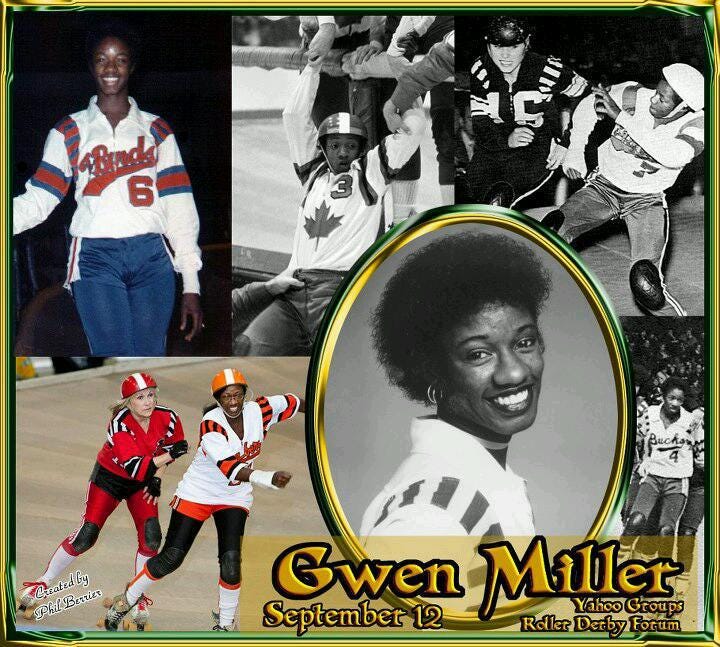
By all accounts, she found it reductive. She was a professional athlete — Rookie of the Year on the Los Angeles Thunderbirds in 1969, one of the most recognizable women’s sports figures in North America through the 1970s, drawing somewhere in the neighborhood of 15 million television viewers a week at the sport’s peak. She was known for leaping over entire packs of skaters, for a speed and agility that made her teammates call her one of the baddest women they’d ever seen. One of her best friends was Pam Grier. She was also, in her off hours, a schoolteacher.
And she was Skinny Minnie. The name stuck, made her iconic, and followed her all the way to her death in 2017. She was the most beloved Canadian roller derby icon of her generation, the face of the LA T-Birds to a generation of fans, a woman who gave everything to a sport that was part genuine athletics and part theater and never quite figured out which part it wanted to be.
I’ve been thinking about her a lot lately because I named a fictional skater after her. And then I played that skater through two bouts of The Circuit, my solo RPG about women’s roller derby in the 1970s, and something unexpected happened.
The Game I Made
The Circuit started from a simple question: what was it actually like to be those women?
Not the spectacle version. Not the Saturday morning television version with the banked track and the drama. The working version. The version where your promoter corners you in a parking lot before warm-up and tells you what he needs from you tonight, and you have to decide what you’re willing to give.
The game runs on two resources: Bruises, which track what your body has absorbed, and Spotlight, which tracks your value to the circuit’s economy. Those two things are almost always in tension. Taking the hit that thrills the crowd costs you a bruise. Protecting yourself costs you spotlight. The promoter has opinions about both.
You pick an archetype before you play. There’s the Jammer, the crowd favorite who lives and dies by spotlight. The Blocker, the wall who takes hits so someone else can score. The Veteran — and this is the one I played — who starts the game already carrying damage. She’s been here. She knows how it works. Once per bout she can call a rigged jam before it costs her. Name what the promoter is asking. Make it visible.
Before the first bout, the game asks one question: What do you want from the circuit?
My skater wanted one more season. A clean finish. To leave on her own terms.
I named her Skinny Minny Miller. In tribute to the Queen.
What Happened When I Played
The fairground pavilion. Eddie Falk, her promoter, smells like bourbon. His instruction: stir up the crowd, anyway you want. It’s the instruction with the most freedom and the most ambiguity. With Eddie, it’s usually both.
The Kansas City Killers are the opposition. Their jammer is Big Betty Crane. Minny’s faced her before. Betty remembers the last time.
First jam: Minny skates real. She breaks through the KC pack on the outside, takes a hit from Betty’s blocker across the shoulder, gets through. The crowd comes up. She marks a bruise. The shoulder is the same shoulder from last bout and she knows it.
Between jams, Eddie appears at the rail with a new instruction. A Killers sponsor is in the building. He needs her to take a fall in jam three. Just a stumble. Nobody will know.
She looked at him for a long time. He didn’t meet her eyes. That’s how she knew it was worse than he was saying.
Second jam: she skates the best jam of the night. Rolls an 11. Maximum spotlight. The crowd loses its mind. Eddie, watching from the third row, slowly uncrosses his arms. He needs this from her and she knows he knows it.
That’s when she calls it. The Veteran’s ability. She tells Eddie the fall is off. He can’t argue. She’s the draw. He loses standing. She keeps her integrity.
Third jam: she refuses the script entirely. Skates clean. Betty nods at her afterward. That nod is worth more than the gate money.
The second bout was Cincinnati. Away game. A blocker named Greta Heiss who hits like she knows where you’re going before you do. By the end of that bout, Minny’s bruises had crossed the threshold where her body starts making choices for her. Not a separate injury mechanic. Just the number on the track changing what she’s trying to do. She wasn’t maximizing spotlight anymore. She was managing the knee.
She won. Dale Crisp, the Cincinnati promoter, nodded once at the rail. Her teammate Patches skated clean backup all night and didn’t need her once.
That last detail went in the journal unprompted. Patches is becoming something. Minny should probably tell her that.
What I Keep Thinking About
Gwen Miller gave twenty years to the Los Angeles Thunderbirds. She was their unofficial queen through the late seventies, the fan connection that management consistently overlooked and underplayed because they were busy chasing “model type” skaters. The very special thing she had with the crowd was real and inconvenient and they never quite knew what to do with it. The circuit didn’t end for her so much as drift away — the sport’s economics collapsed, television moved on, the banked track era closed.
She stayed a schoolteacher. She hated the nickname. The nickname is how everyone remembers her.
There’s something in that gap — between what a woman gives a sport and what the sport gives back, between the name she chose for herself and the name that stuck — that The Circuit is trying to hold. Not as tragedy. Not as tribute. As the actual texture of what it cost to be those women.
The game is pay what you want. You need two dice, a journal, and an hour or two. You’ll probably name your skater something that means something to you. You’ll probably find out what she wants before the first jam is over.
You can find it at jgesq.itch.io/the-circuit.
Lace up anyway.
-Julian
What a brilliant story and a great basis for a game
It’s compelling